


Home | Gallery
Guide | The Provincetown AIDS Art Archives Contact Us | How You Can Help
A | B | C | D | E | F | G | H | I | J | K | L | M | N | O | P | Q | R | S | T | U | V | W | Y | Z
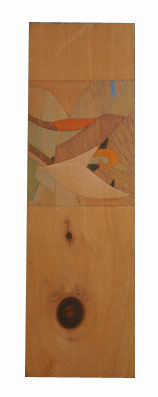
Wood block cut with design by Barbara Stoughton
History of the Provincetown Print

The Provincetown Print, a unique method of color printmaking produced with a matrix of a single block of wood, was developed in 1915 by B.J.O. Nordfeldt in Provincetown, Massachusetts.
The method was adopted by a small group of American artists working in Provincetown, who had returned to America after the outbreak of WWI in Europe. This original group included Ada Gilmore, Mildred McMillen, Ethel Mars, Maud Squire, and Juliette Nichols, in addition to Nordfeldt.
This method of printmaking caught on rapidly by artists working in Provincetown in the mid-teens and early twenties.
Perhaps the most notable practitioner of the method was Blanche Lazzell, who learned the technique from Oliver Chaffee in l916. Lazell taught many students and was a prolific artist.
One of Lazzell's students was Ferol Sibley Warthen, who learned the method in 1950. Warthen, in turn, taught many artists this method of printmaking, among them Kathryn Lee Smith, her granddaughter. Smith has been making white-line woodblocks since the l980's and in turn has taught hundreds of students.
In 1983 the Smithsonian Institute combined its resources with the Provincetown Art Association resulting in a joint exhibition of white line prints, curated by Janet Altec Flint. This exhibition brought a resurgence of interest in this method of printmaking.
Other artists working in this method since the l980's include William Evaul and Ruth Hogan.
The Provincetown Print employs a single block of wood to produce a color print. The block is cut with a linear design and then hand-colored, with each individual section printed one at a time, by hand. By nature, no two prints are exactly alike. "Editions" are open-ended, and, as each print is rendered individually, every print is unique.
-Kathryn Lee Smith, 2009
..................................................
Established in 2001 © Provincetown Artist Registry | P.O. Box 675, North Truro, MA 02652 | 508 487-0011